




-

"Very nice Posters. The quality is amazing and we received it very quickly !"
-

"A shop to visit absolutely. Huge selection of posters. We spent more than an hour there !"
-

"Perfect to find gift. Price are very good. An they can frame and pack it on site"


About the Artist
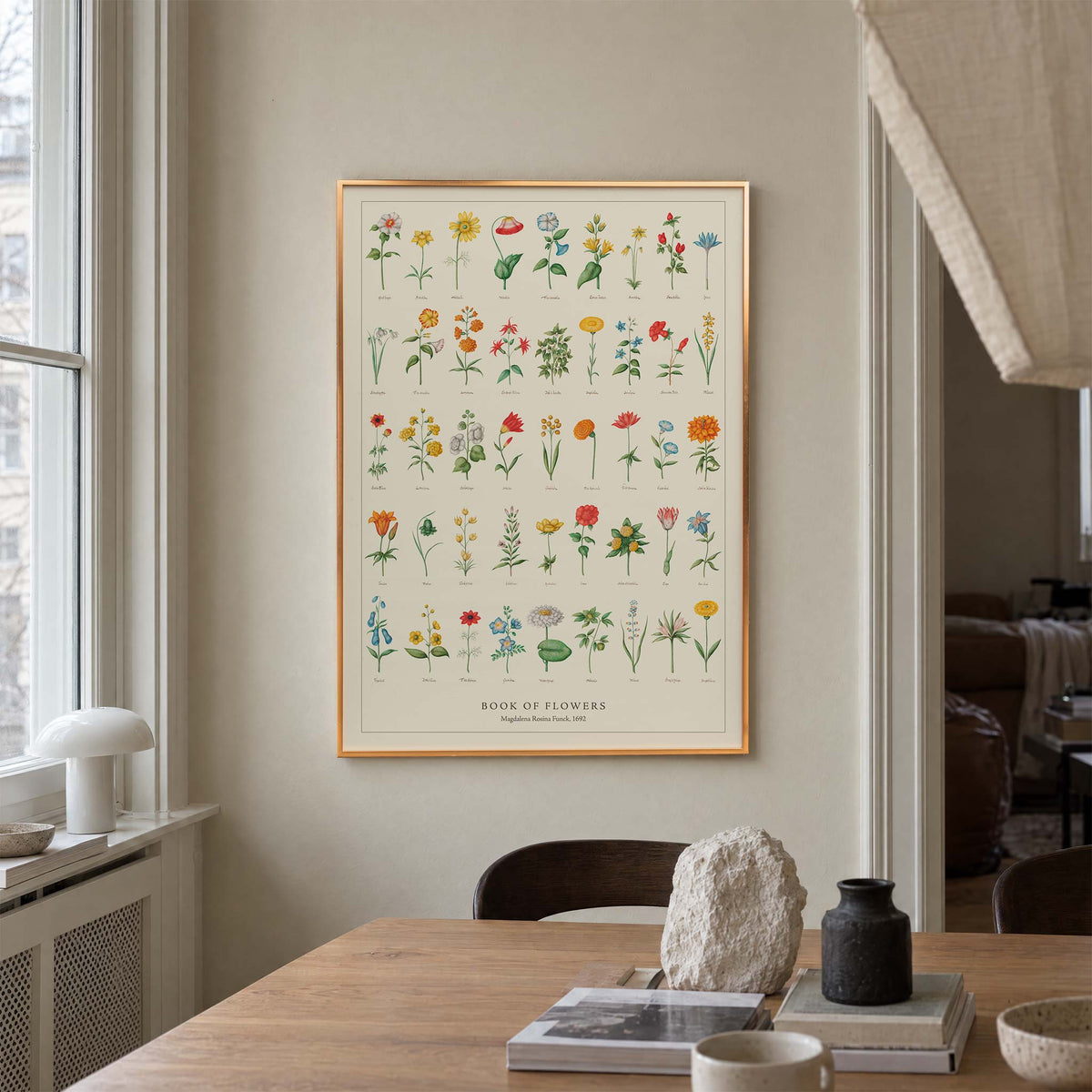
Magdalena Rosina Funck is the name credited beneath Book of Flowers, alongside the date 1692. That attribution connects this botanical print to a woman whose flower studies remain the focus here, rather than to a biography the image cannot supply. Her subject offers a direct point of entry: the flowering plant, considered individually rather than as part of a distant landscape. For anyone exploring botanical art by Magdalena Rosina Funck, this art print introduces a historical approach to looking at garden subjects, where attention rests on the particular flower rather than an unfolding scene.
The Artwork
Book of Flowers promises a garden that can be revisited beyond its flowering season. The title connects the image to the experience of consulting an illustrated volume, returning to familiar plants while discovering others. The supplied date, 1692, places its source in the seventeenth century, though it does not establish a particular commission or scientific purpose. Seen today as a vintage print, the work invites reflection on how images preserve encounters with nature. Its transformation into a vintage poster brings that bookish encounter onto the wall, where botanical observation becomes part of an everyday routine.
Style & Characteristics
Five rows of flowering plants lead the eye across a pale cream ground before drawing it downward. Each stem has its own space, so a bent flower head remains distinct from an upright bloom nearby. Red petals recur across the sheet, while blue flowers interrupt the warmer passages. Fine green stems support blossoms that vary considerably in size and shape. Small labels appear beneath the plants, but are not legible at this scale. At the bottom of the vertical poster, widely spaced capital letters spell Book of Flowers above the smaller artist credit and date.
In Interior Design
Place this botanical wall art above a narrow oak writing desk beside a window, where daylight allows the smaller flowers to be studied from a chair. A slim dark frame would echo the lettering without competing with the stems. Keep the wall around the fine art print clear, allowing its rows to become the main detail above the desktop. For home decor built around a daily writing ritual, the flower studies offer something specific to revisit between pages. Let the cream ground guide the interior decoration here, repeating its warmth in the wall behind the desk.