


You may also like
-

Seated nude back view Poster
Egon Schiele · 1917 · A vintage poster art print of a seated nude in expressive contour lines
Poster from €9 · Framed from €16
-

Gertrude Poster
Egon Schiele · 1910 · Expressive nude figure art print with spare linework and warm earthy tones
Poster from €9 · Framed from €16
-

Squatting Female Nude Poster
Egon Schiele · 1910 · Taut squatting nude art print with angular pose and spare, intimate negative space
Poster from €9 · Framed from €16
-

Two Friends Poster
Egon Schiele · 1912 · Tense, tender figurative art print of two entwined nudes on warm paper
Poster from €9 · Framed from €16


-

"Very nice Posters. The quality is amazing and we received it very quickly !"
-

"A shop to visit absolutely. Huge selection of posters. We spent more than an hour there !"
-

"Perfect to find gift. Price are very good. An they can frame and pack it on site"


About the Artist
Egon Schiele was one of the most distinctive voices of Austrian Expressionism, active in Vienna during the early twentieth century. A younger contemporary of Gustav Klimt, he became known for psychologically charged figure studies that pushed portraiture and the nude into more candid, modern territory. Today, Schiele remains a major name in Egon Schiele prints, admired for turning the human body into a language of tension and feeling.
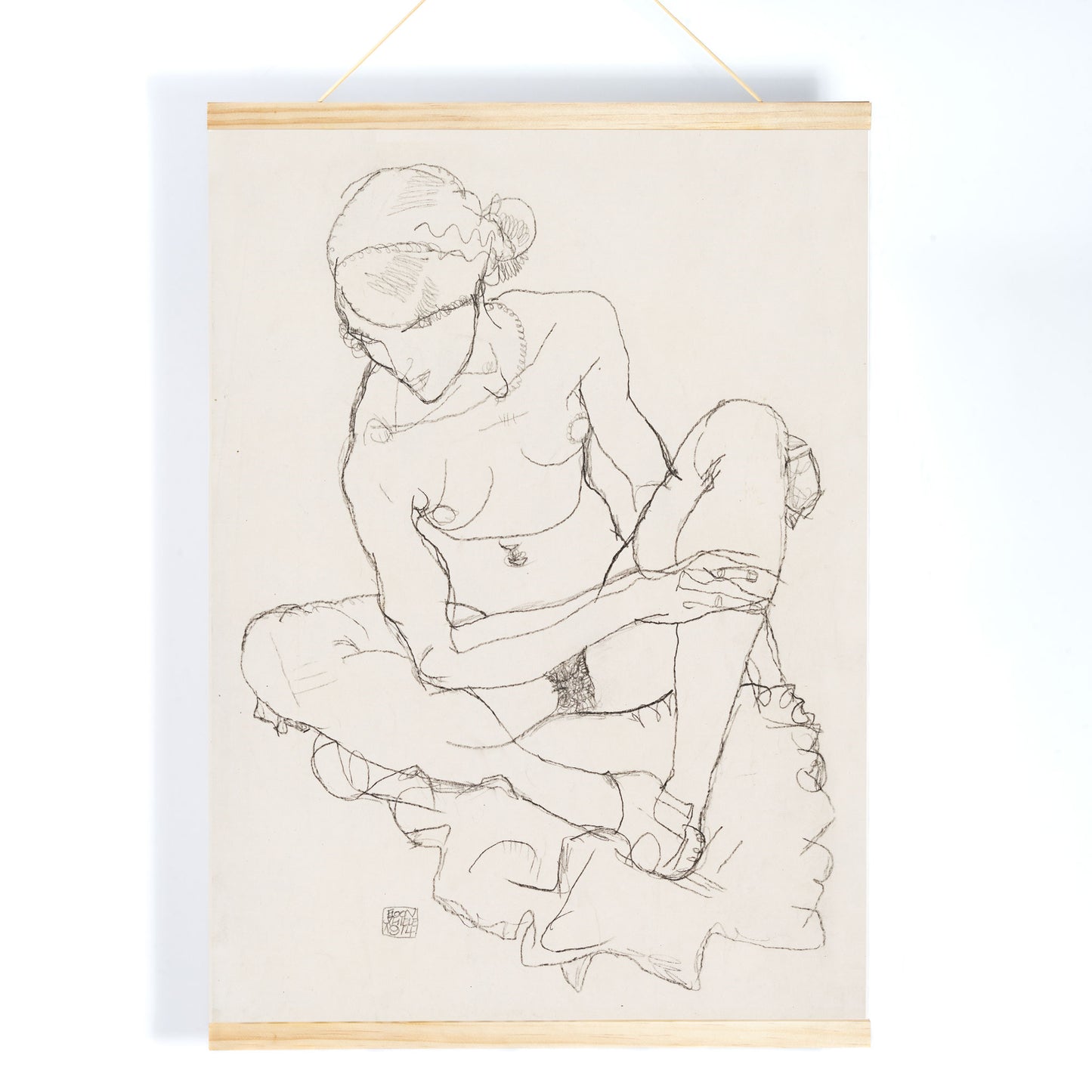
This 1914 work belongs to a decisive moment in his career, when his draftsmanship had become both sparer and more penetrating. For collectors of a vintage fine art print, it offers a direct encounter with the radical sensitivity that made Schiele central to modern European art.
The Artwork
Seated nude woman belongs to a period when artists across Vienna were questioning inherited ideals of beauty, decorum, and identity. Rather than presenting the body as a distant classical symbol, Schiele approached the nude as a living, vulnerable presence. The seated pose suggests inward concentration and self-possession, inviting the viewer to consider solitude, self-awareness, and the tension between exposure and inwardness.
Created in 1914, the work also sits on the edge of a world about to change dramatically. As a result, this figure study carries a remarkable modernity, making it more than a study of form. It becomes a meditation on the individual body as subject, psychology, and presence in art history.
Style & Characteristics
This black and white composition is strikingly spare, built from fine, nervous line rather than dense modeling. Large areas of untouched paper give the figure room to breathe, while the contour shifts between delicate and jagged, creating a rhythm that feels both controlled and unsettled. The body is arranged in a compact, curling posture that gives the image movement despite the seated pose.
What defines this minimalist art print is its economy. There is little visual distraction, only the expressive power of outline, subtle sketch marks, and asymmetrical balance. The result is intimate and arresting, with the raw immediacy of drawing and the refined presence of black and white posters.
In Interior Design
This poster works beautifully in calm, curated spaces where line and negative space can take center stage. It suits bedrooms, reading corners, dressing rooms, and modern living areas, especially interiors that favor monochrome palettes, natural wood, stone, or soft linen textures. As minimalist posters go, it has enough emotional depth to warm a pared-back room without overwhelming it.
It also makes an elegant addition to a gallery wall built around expressive drawing, classic modernism, or figurative decorative art. For home decor that feels intellectual yet personal, this vintage print pairs especially well with black frames, neutral walls, and restrained interior decoration in white, beige, or grey.