




-

"Very nice Posters. The quality is amazing and we received it very quickly !"
-

"A shop to visit absolutely. Huge selection of posters. We spent more than an hour there !"
-

"Perfect to find gift. Price are very good. An they can frame and pack it on site"


About the Artist
Scissors gave Henri Matisse a way to keep making art when working at an easel grew difficult. He cut shapes from paper painted with gouache, treating the blade as a drawing tool rather than a means of trimming a finished image. In 1947, the year of White Alga on Red and Green Background, his cut-paper book Jazz appeared in print. That shared date places this work within his late experiments without making it an illustration for the book. As a Henri Matisse fine art print, it recalls an artist finding new possibilities in the simple act of cutting paper.
The Artwork
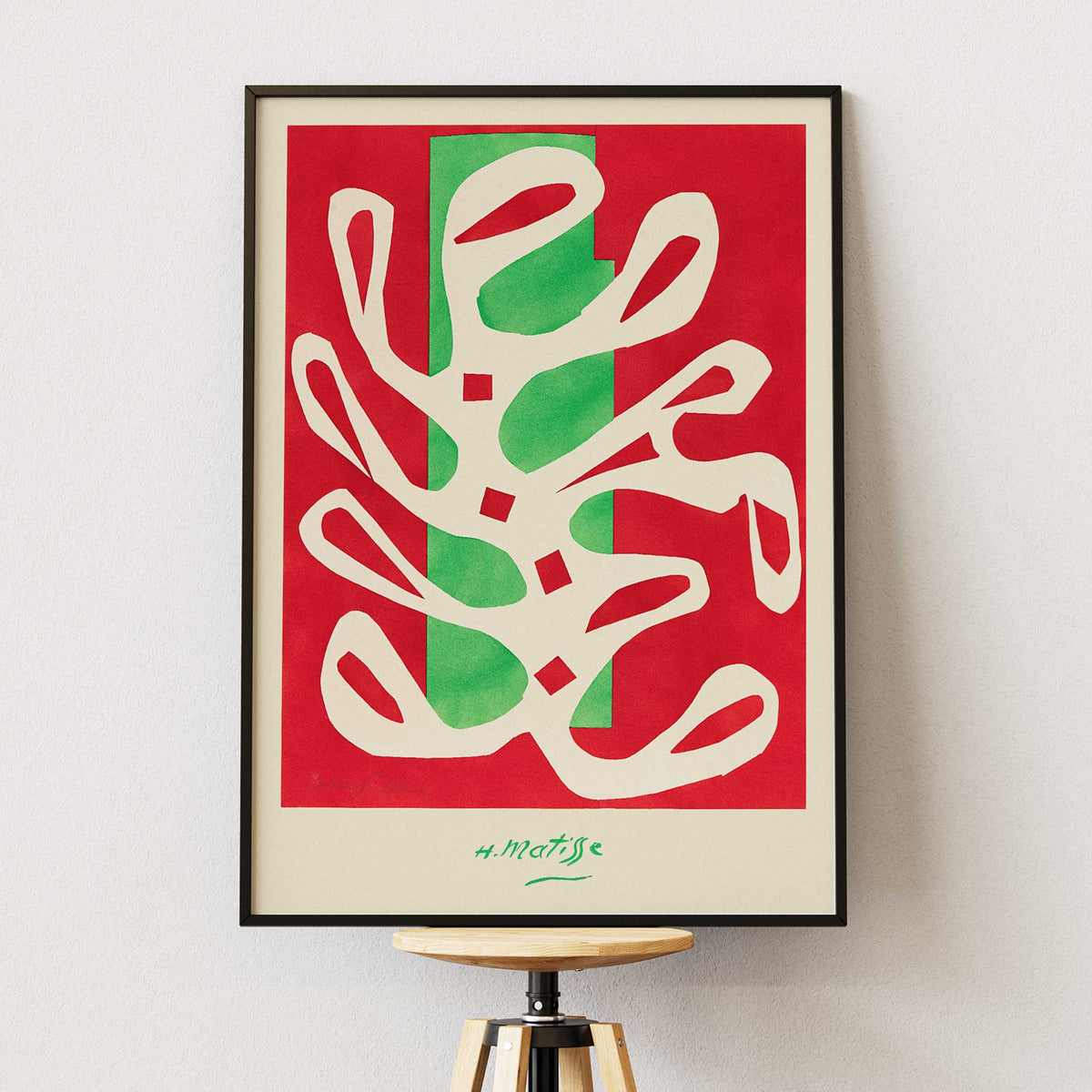
Why choose an alga instead of a conventional landscape? The subject evokes the sea without naming a place or recording a botanical specimen. Its title identifies a living form but leaves viewers free to imagine the currents around it. Made in 1947, the work comes from a period when cut paper had become central to Matisse’s art. A pencil sketch on the reverse of the original offers a further glimpse of his creative process, though its relationship to the front is not clear. Reproduced as a vintage print, White Alga on Red and Green Background invites an imaginative journey underwater.
Style & Characteristics
White ribbons spread across a saturated red field, looping around openings that let the background show through. Green appears in a tall central band and in broad patches glimpsed between the branching forms. Several small red squares interrupt the white, so the eye hops from one gap to the next before following a longer curve. The cutout widens and narrows as it travels across the image, giving this abstract wall art a sense of movement without depicting a current. At the bottom, a green signature rests in the pale margin. The vertical poster holds its wandering lines inside a rectangular border.
In Interior Design
Above a low oak sideboard in a dining room, this vertical poster can make a quiet wall feel almost tidal. A single green ceramic bowl picks up the green behind the alga, while the broad red field brings warmth to the room on grey afternoons. Leave some space around the frame: the white cutout reaches so close to the picture edges that crowded surroundings would mute its sense of motion. For home decor built around natural wood, the art print introduces an unexpected botanical form. Here, interior decoration takes its cue from the imagined movement of water rather than a literal coastal theme.